Aviation, Sustainability, and the Somali Diaspora: Holding Two Truths at Once

In this Spotlight, Ibrahim Abdi, co-founder of Somalis for Sustainability, reflects on the tensions and possibilities at the intersection of aviation and climate responsibility. He examines how the Somali diaspora can support global mobility while advancing sustainable solutions, holding both truths with clarity and purpose.
Spotlight Series: Ibrahim Abdi
Flying plays a central role in today’s world. It connects people across borders, enables trade, supports tourism, and sustains livelihoods. For many of us in the Somali diaspora, while flying is a luxury, it is also not something taken for granted. It is a means of returning home to visit family, to maintain connection across distance, and, in moments of crisis, a way to deliver humanitarian support.
Yet aviation also sits at the centre of one of the most difficult sustainability conversations of our time. Demand for air travel continues to grow globally, particularly across emerging markets, raising an unavoidable question: how do we preserve the benefits of aviation while reducing its environmental impact at the pace the climate crisis demands?
Globally, aviation contributes around 2–3% of total CO₂ emissions, with a higher warming impact when non-CO₂ effects such as contrails are included. This creates a tension that is hard to ignore: the very system that enables global connection also contributes to a climate crisis that disproportionately affects vulnerable regions.
Holding these two truths at once is uncomfortable, but necessary.
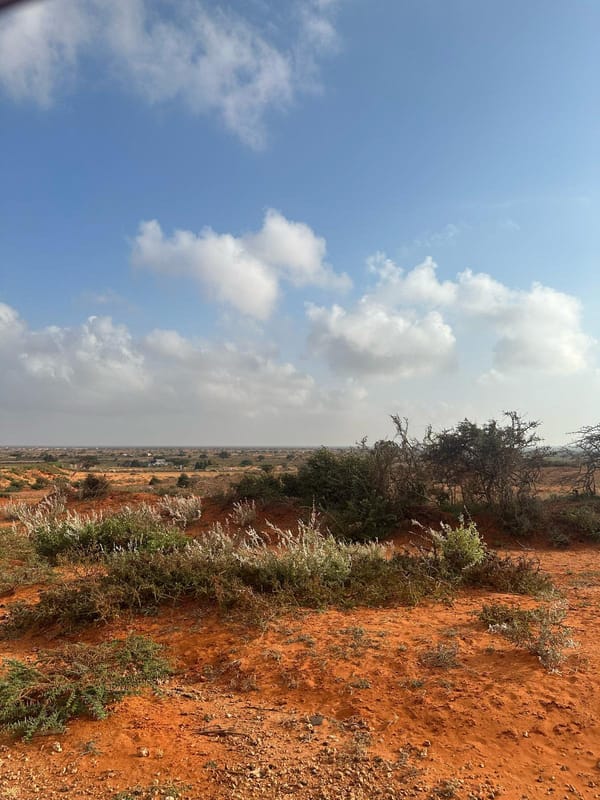
Global conversations on aviation sustainability rarely account for places like the Somali Horn, where aviation infrastructure is minimal, but the consequences of climate change are anything but.
This piece is not an argument for or against aviation. It is an attempt to sit honestly with that tension, and to explore what sustainability means when applied to a region where aviation infrastructure is minimal, but climate vulnerability is high.
Why aviation is a hard sector to decarbonise
Aviation is often described as a hard-to-abate sector, and for good reason. Unlike road transport, where electrification is already widespread, long-haul aircraft cannot currently rely on batteries due to weight and energy-density constraints. Hydrogen and electric aircraft show promise for the future, particularly for short-haul routes; however, these technologies remain years away from operating at a commercial scale.
In the near to medium term, aviation’s emissions reductions rely largely on operational efficiency, newer aircraft, and Sustainable Aviation Fuel (SAF). SAF can reduce lifecycle emissions by up to 80% compared to conventional jet fuel, depending on how it is produced.
However, global SAF supply remains extremely limited, accounting for 0.2% of total aviation fuel use. This gap between ambition and reality defines the challenge facing aviation: progress is possible, but constrained by cost, infrastructure, and technology.
Aviation exists, but not for most Somalis
When discussing aviation and sustainability in the Somali context, honesty matters. Domestic aviation in the region is extremely limited, and for the vast majority of the population in the Somali Horn, flying is simply not accessible. Most people have never been on a plane, and many struggle to afford even basic ground transport. According to data from The International Civil Aviation Organisation from 2019, passenger numbers are among the lowest reported globally, reflecting both affordability constraints and limited domestic connectivity.
There is currently no meaningful conversation around “sustainable aviation” within the region itself, not because it is unimportant, but because foundational infrastructure, governance, and economic stability are still being rebuilt. In this context, sustainability cannot be layered onto aviation systems that barely exist.
Where aviation does play a role is in diaspora travel and humanitarian response. For the Somali diaspora, flying is often the only practical way for us to maintain family ties across borders and return home when possible. Additionally, with limited road and rail infrastructure, aid, medical supplies, and emergency support are also frequently flown into the country during droughts, floods, and periods of instability, a reality reflected in long-running operations such as the UN Humanitarian Air Service.
This is why climate solutions must be context-sensitive. Blanket calls to “fly less” may resonate in parts of the Global North, but they risk overlooking realities where alternative transport options simply do not exist, and where connectivity underpins humanitarian response and basic survival.
This distinction matters. Much of the global aviation sustainability debate assumes widespread access to air travel. That assumption does not hold in the Somali Horn, yet the region consistently ranks among the most climate-vulnerable countries in the world, according to the ND-GAIN Climate Vulnerability Index.
Regional reference points and future potential
While the Somali Horn’s aviation sector remains constrained, neighbouring Ethiopia offers a regional reference point. Ethiopian Airlines has built one of Africa’s largest aviation networks, investing in newer aircraft, operational efficiency, and long-term decarbonisation planning aligned with global aviation goals.
Ethiopia’s context is different, politically, economically, and institutionally, but its aviation sector demonstrates that African-led aviation growth is possible. More broadly, Africa holds long-term potential for cleaner aviation pathways. Organisations such as IATA have highlighted the continent’s future SAF feedstock potential, including agricultural residues and waste streams, if enabling policy and investment frameworks are established.
For the Somali Horn, this is not about immediate adoption. It is about future-proofing, ensuring that when aviation capacity grows, it does not lock the country into outdated, high-emissions systems.
The Somali diaspora and the weight of distance
As the Somali diaspora, we maintain deep emotional, familial, and cultural ties to the region. Aviation is often the physical bridge that sustains those ties, enabling visits home and supporting relatives.
Somalis for Sustainability is helping the diaspora understand both the realities of climate change and the fragility of systems across the Somali Horn. We also understand that climate conversations cannot be abstract or imported wholesale; they must reflect lived conditions.
If sustainability frameworks continue to overlook places where infrastructure is minimal but vulnerability is high, they risk reinforcing the very inequalities they seek to address.
Looking ahead
Aviation will continue to shape how the Somali diaspora connects with home and how the region engages with the wider world. The question is not whether aviation has a role to play, but how that role evolves over time.
For the Somali Horn, the priority today is access, stability, and resilience.
If sustainability is to mean anything globally, it must be able to speak honestly to places where systems are fragile, access is uneven, and responsibility is not shared equally.
Connect with Ibrahim on LinkedIn.
Find Somalis for Sustainability on Instagram, LinkedIn, Tiktok and X.